


Unplanned downtime carries costs that can cripple an organization. For data center operations managers, that reality transforms commissioning from a checkbox exercise into mission-critical insurance. Yet many leaders inherit newly commissioned facilities without truly understanding whether the power systems were properly validated or what this means in practice.
This guide bridges that gap. You’ll learn how load bank testing validates critical power infrastructure during integrated systems testing, what to observe during commissioning, and which benchmarks confirm your facility can handle real-world demands. By the end, you’ll have the framework to ensure data center uptime.
Why Rigorous Power System Validation Is Nonnegotiable
The financial stakes of power system failure continue to escalate. Over 90% of large enterprises now face average hourly downtime costs exceeding $300,000, with 41% reporting costs between $1 million and over $5 million per hour. These figures exclude litigation and regulatory penalties, making the true cost even higher.
Compounding this challenge, data centers face projected energy consumption that could potentially double or triple by 2028, placing unprecedented strain on critical power infrastructure. This convergence of rising demand and escalating consequences makes rigorous critical power system validation essential for ensuring data center uptime.
Forward-thinking data center power solutions from partners like Sunbelt Solomon start with a structured commissioning approach to identify and resolve issues before they impact operations. This process transforms potential failures into documented, resolved challenges — giving operations managers confidence in the infrastructure they’ll manage for years to come.
Understanding the 5 Levels of Data Center Commissioning
Data center commissioning follows a structured five-level framework, with methodologies detailed in resources like ASHRAE’s data center guidelines. This structured approach ensures quality control at every stage, from the factory floor to the final integrated test.
Levels 1-3: Factory to Functioning Sub-System
The foundational commissioning levels verify individual components and basic functionality before system integration begins. Factory testing at Level 1 confirms individual components against manufacturer specifications. Upon delivery, Level 2 checks equipment integrity, inspecting for shipping damage and verifying that what arrived matches what was ordered. The final foundational stage tests the initial power-up and basic functionality of individual equipment pieces in their installed locations.
These early stages ensure every component entering your data center meets baseline performance standards.
Level 4: Functional Performance Testing
At this stage, commissioning moves from individual components to full subsystems. Level 4 validates distinct systems as functioning units. Commissioning engineers test entire subsystems — a full uninterruptible power supply (UPS) system, the entire cooling loop or the electrical distribution chain — to confirm that each subsystem performs to specification independently.
This level answers the question: Does each major system work correctly on its own?
Level 5: The All-Important Integrated Systems Test
This stage marks the moment when all prior validation work culminates in comprehensive testing. Level 5 — integrated systems testing (IST) — is the crucial test in which load banks simulate full operational conditions to prove that all systems work together seamlessly during power failures and recovery scenarios.
IST testing procedures validate that systems work together as an integrated system under real-world conditions. This includes:
- Generators
- UPS systems
- Automatic transfer switches
- Cooling infrastructure
- Monitoring systems
Understanding the fundamentals of load bank testing becomes essential, as this equipment enables testing before expensive IT hardware occupies the facility.
A Manager’s Guide to the Load Bank Testing Process
For data center managers overseeing commissioning, load bank testing is your primary window into power system reliability. This section provides the technical knowledge needed to be an informed stakeholder during IST testing procedures.
What Is a Load Bank and How Does It Simulate Full IT Load?
Load banks are the primary testing tool for validating power capacity without risking production equipment.
A load bank is a precisely controlled electrical device that mimics the power consumption and thermal output of a fully populated data hall. Rather than risk expensive servers during commissioning, these devices provide a safe, adjustable “dummy load” that draws real power and generates real heat. This allows commissioning engineers and power and cooling suppliers to validate infrastructure performance under authentic conditions before any production equipment enters the facility.
Resistive vs. Reactive Load Banks
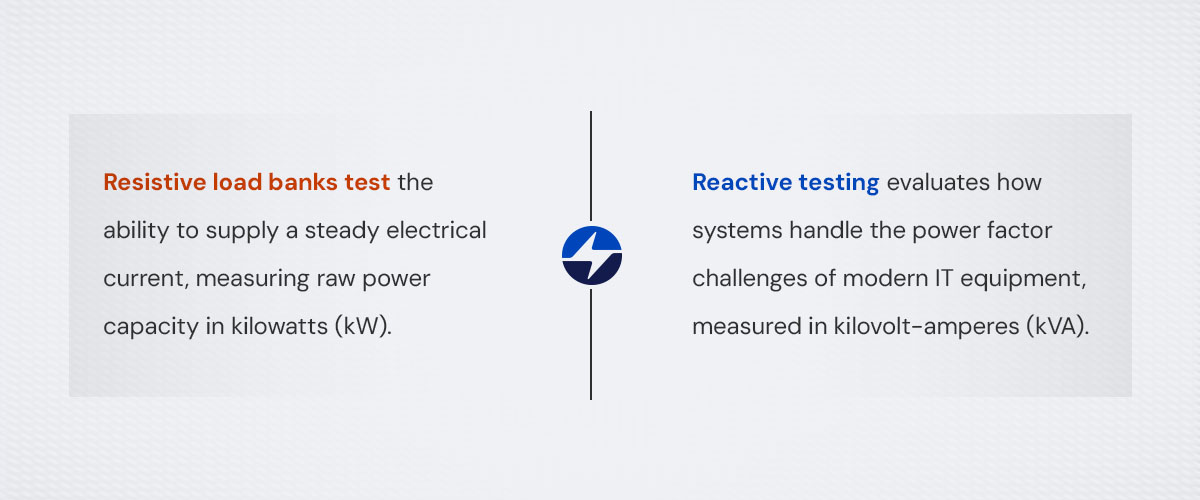
Different load bank types verify different aspects of your power infrastructure. Understanding these testing methods clarifies what each approach demonstrates.
- Resistive load banks test the ability to supply a steady electrical current, measuring raw power capacity in kilowatts (kW).
- Reactive testing evaluates how systems handle the power factor challenges of modern IT equipment, measured in kilovolt-amperes (kVA). It examines the phase relationships between voltage and current.
Reactive testing has become critical as contemporary UPS systems and generators must manage the inductive and capacitive loads created by switching power supplies in servers and storage systems. Heat-load testing methods using reactive banks determine whether your infrastructure can withstand these real-world electrical characteristics.
What to Expect on Testing Day
Knowing the testing sequence prepares you to observe key validation moments. IST testing follows a structured progression designed to stress systems gradually while monitoring performance continuously:
- Safety briefing and walk-through: Commissioning engineers review test procedures, emergency protocols and observation points for stakeholders.
- Staged load application: Load increases incrementally — typically 25%, 50%, 75%, then 100% of design capacity — with monitoring at each plateau.
- Sustained full-load period: Systems operate at maximum capacity for extended periods, often several hours, to confirm thermal stability.
- Simulated failure scenarios: Engineers trigger automatic transfer switch activation, generator startup sequences and UPS transitions to validate seamless failover.
- Monitored cooldown: Controlled load reduction occurs while verifying that systems return to stable idle states.
Your role as operations manager during testing is to observe, ask questions about any anomalies and understand what normal performance looks like for your infrastructure.
Key Validation Benchmarks
These criteria empower you to verify successful testing through observable criteria and documented evidence.
Verifying Performance
Electrical system stability under load reveals infrastructure reliability. Watch for steady voltage and frequency output from generators and UPS systems throughout load transitions. Voltage should remain within about 5% of nominal ratings and frequency within about 0.5 Hz. Automatic transfer switches should transition seamlessly with no visible dropout or flickering.
Listen for abnormal sounds from electrical switchgear — humming, buzzing or crackling can indicate loose connections or overheating components.
Monitoring Thermal Stability Under Full Load
Heat management validates cooling capacity and electrical connection integrity. Thermal performance validation requires sustained observation under maximum load conditions. Commissioning engineers should use thermal imaging cameras to scan electrical connections, breaker panels and transformer terminals for hot spots that indicate resistance or inadequate connections. Computer room air conditioning (CRAC) units or computer room air handlers (CRAH) must maintain stable temperature and humidity throughout extended testing, demonstrating adequate capacity for your anticipated IT load.
Reviewing the Final Report for Confidence and Compliance
The commissioning report becomes your operating baseline and proof of compliance. This final documentation serves as your handbook and compliance record.
Request detailed logs of all key metrics captured at regular intervals throughout testing. This includes:
- Voltage
- Frequency
- Temperature
- Humidity
The report should include a clear narrative of the test sequence, any anomalies encountered and their resolution and a definitive pass/fail statement for each system and the integrated facility as a whole. This document becomes your baseline for performance and evidence of due diligence.

Ensure Mission-Critical Reliability With Sunbelt Solomon
Validating critical power systems with load banks demands expertise, speed and comprehensive support alongside quality equipment. Sunbelt Solomon provides turnkey electrical solutions designed to keep your project on schedule, from Reman® transformers with enhanced warranties to temporary power equipment rentals that eliminate costly delays. Our services include equipment sales, repairs, field service and ongoing maintenance focused on ensuring data center uptime.
Our team delivers the quality equipment, rapid lead times and field service expertise data center operations need. Whether you need contingency planning for commissioning or ongoing support to maintain reliability, we’re your partner for resilient power infrastructure.
Contact us today for a quote and discover how Sunbelt Solomon supports mission-critical facilities across North America.