




With U.S. battery storage capacity increasing by 66% in 2024 alone, verifying complex systems has become critical for project developers and operators. An untested or underperforming inverter or battery energy storage system can lead to revenue loss, grid instability and regulatory failures. This guide provides a framework for using load banks to test and validate your solar inverters and battery systems for reliable and compliant performance.
Why Rigorous Testing Is Essential for Solar and BESS Projects
Rigorous load bank testing provides the data needed to validate financial returns, regulatory compliance and long-term performance.
Maximizing ROI by Preventing Costly System Failures
There’s a direct correlation between system availability and revenue. While median availability for solar systems reaches approximately 99%, conservative estimates average 95%. Load testing identifies which category your project falls into before it impacts your bottom line.
Since inverter availability is the lowest in the first six months, rigorous commissioning tests catch infant mortality failures early. Verifying renewable energy performance through measured output during commissioning protects your investment and provides a performance baseline for validating warranty claims.
Ensuring Grid Stability and Regulatory Compliance
Modern grids require distributed energy resources like solar and BESS to be grid-supportive for stable voltage and frequency. The IEEE 1547-2018 standard governs how these assets behave when interconnected. As a solar inverter testing standard, it defines technical requirements for safe grid integration.
Load bank testing demonstrates compliance with IEEE 1547 requirements, including voltage and frequency ride-through and power-quality limits. Satisfying these grid interconnection requirements supports utility approval.
Validating Performance for Commissioning and Maintenance
Load bank testing serves critical functions throughout a system’s life cycle:
- Commissioning: Confirms the as-built system matches design specifications. For a solar and storage facility, this includes verifying the inverter transitions between operating modes correctly and that the BESS delivers its rated capacity. Proactively addressing BESS commissioning challenges prevents costly rework.
- Preventive maintenance: Scheduled testing to detect degradation in battery capacity or inverter efficiency, allowing for proactive repairs and tracking decline.
- Fault diagnosis: Replicates specific operating conditions to troubleshoot underperforming equipment and isolate root causes.
- Post-repair validation: Verifies that repairs or replacements have restored the system to expected performance levels.
Sunbelt Solomon offers comprehensive load bank testing guidance to help you implement these protocols.
Understanding the Components in a Testing Scenario
A successful test requires understanding components. The inverter controls the conversion process, the battery provides power and the load bank applies the controlled load.
1. The Solar PV Inverter
An inverter converts DC electricity from the BESS into grid-compliant AC electricity. As a smart or grid-forming inverter, it also manages critical services like voltage regulation, frequency response and power factor correction. Testing evaluates the inverter for stability and response to simulated grid conditions. The U.S. Department of Energy defines these capabilities as essential for solar integration and grid services.
2. The BESS
For testing purposes, the BESS acts as the stable, high-current DC power source. The test validates the BESS’s ability to discharge at rated capacity without overheating or voltage drop, confirming its state of health and capacity to support the inverter under maximum load.
Load testing also stresses the BESS thermal management system, revealing potential issues with cooling, cell balancing and voltage inconsistencies.
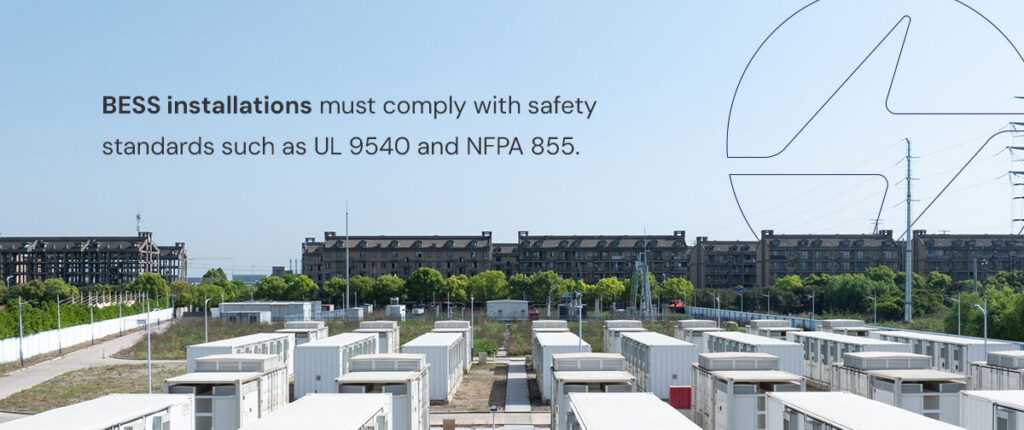
BESS installations must comply with safety standards such as UL 9540 and NFPA 855. Adherence to these requirements future-proofs your power infrastructure for renewables.
3. The Load Bank
Load banks provide fully controllable testing capabilities.
- Core function: Acts as an artificial electrical load, allowing engineers to simulate operating conditions without impacting the live grid.
- Resistive load banks: Simulate real power to verify real power capacity. Use for full-load verification and thermal stress testing.
- Reactive load banks: Simulate apparent power to test the inverter’s power factor management. Often required by utilities.
- Combined units: Offer comprehensive testing for complete power profile simulation. Use when the test plan requires simultaneous real and reactive power validation, such as full IEEE 1547 compliance testing.
A Framework for Performing Load Bank Tests
A safe, successful load test follows a methodical process.
1. Pretest Planning and Safety Protocols
Proper preparation is essential.
- Develop a written test plan: Detail objectives, including full load capacity test, ramp rate verification and fault ride-through.
- Conduct a comprehensive safety review: Include job safety analysis, arc-flash boundaries and verification of temporary cable connections.
- Address BESS-specific safety hazards: Ensure proper lockout/tagout procedures and establish emergency response protocols for thermal events.
- Ensure proper sizing: Verify the load bank and cables match the maximum system output.
- Verify BESS readiness: Confirm the BESS has a full charge and is ready for sustained discharge testing.
2. Simulating Real-World Load Conditions
Begin by applying a small initial load to verify stable operation. Gradually step up the load in increments, holding at each interval for a few minutes.
For solar and BESS systems, extend the standard step-test. Test inverter performance at multiple battery states of charge to verify consistent output. Confirm ramp rate compliance by commanding rapid load changes. If designed for islanding, test the transition between grid-tied and islanded operation. These microgrid testing protocols ensure reliable operation in all modes.
Teams should also monitor for alarms or abnormal behavior and conclude the test with a ramp-down and a final check.
3. KPIs to Monitor During the Test
Track these critical metrics.
- AC-side: Voltage and frequency stability, total harmonic distortion and power factor.
- DC-side: BESS voltage drop under load, DC current and state of charge depletion rate.
- Thermal performance: Monitor inverter and battery terminal temperatures using thermal imaging to identify hot spots.
- Efficiency: Calculate the inverter’s conversion efficiency by comparing DC power input to AC power output.
4. Analyzing the Data to Identify Potential Issues
After testing, conduct a thorough data analysis:
- Pass/fail criteria: Compare recorded data against manufacturer specifications and standards like IEEE 1547.
- Common faults: Look for excessive voltage drop, harmonic distortion above limits or thermal runaway.
- Reporting: Compile all data, findings and anomalies into a formal test report serving as the official record.
A Smarter Way to Source Your Testing Equipment
Effective testing methods call for appropriate equipment sourcing strategies. Flexible sourcing is often more strategic than ownership for specialized tasks like load bank testing.
The Advantages of Renting vs. Buying
Renting offers significant operational advantages.
- Avoids capital expense: Renting converts a considerable capital expenditure into a predictable operating expense tied to a specific project.
- Eliminates maintenance and storage: Avoid costs of storing, maintaining and calibrating equipment used only occasionally.
- Access to the right technology: Renting provides access to a wide range of load bank sizes and types for each requirement.
- Scalability: Easily scale testing capacity based on project needs without committing to specific equipment.
Sunbelt Solomon provides detailed guidance on renting versus buying testing equipment to support cost-effective decision-making.
The Value of a Turnkey Rental and Service Partner
A capable partner provides complete, engineered solutions that go beyond equipment rental.
- Expert consultation: They work with you to plan the test, select the correct load bank and deliver all necessary supporting gear tailored to your project requirements.
- Packaged power solutions: A true partner provides packaged power solutions and comprehensive support, not just stand-alone equipment.
- Field technician expertise: Expert technicians ensure safe execution, minimizing delays and ensuring reliable data throughout the testing process.
- Complete project support: Sunbelt Solomon’s temporary power equipment rentals include complete support to maintain your project timeline.

Build Your Custom Testing Solution With Sunbelt Solomon
Successfully commissioning and maintaining a solar and storage facility requires precision and expertise. Sunbelt Solomon is your one-stop shop for testing solutions. We provide a complete turnkey package for your project. Our specialists have over 10 years of experience and can consult on your test plan and answer technical questions.
We supply the full package, including load banks, transformers, switchgear and cable, all sized for your system. We handle end-to-end logistics with fast deliveries to and pickups from your site. Our expert field technicians provide field service and work with you on maintenance plans to keep your electrical distribution equipment performing at its best.
Contact us today to build the testing solution your project deserves.