When the utility grid goes dark, every piece of life-support equipment depends on generators that you’re responsible for maintaining. A generator that won’t start during an outage puts lives at risk and exposes your facility to citations, mandatory corrective action plans and financial penalties.
The regulatory frameworks governing hospital generators are complex. National Fire Protection Association (NFPA) 110 and 99, and the Joint Commission (TJC) standards overlap to create a regulatory maze that can be hard to navigate. Missing a single testing interval or documentation detail can put your accreditation status at risk.
The guide ahead translates code language into actionable tasks you can delegate, track and defend when surveyors arrive, ensuring alignment with healthcare facility maintenance standards.
Why NFPA 110 Is a Critical Concern for Hospital Facility Managers
Generator failures during utility outages immediately jeopardize ventilators, surgical suites, diagnostic imaging systems and electronic medical record access. Equipment failures create patient safety incidents and liability exposure your facility can’t afford.
NFPA 110 testing requirements define how emergency power supply systems must be installed, inspected, exercised and documented. TJC and state surveyors use the standard as their benchmark when evaluating your program.
Gaps in execution or record-keeping will trigger TJC deficiency findings that demand corrective action plans. Repeated violations of hospital backup power regulations can escalate to financial penalties or threaten accreditation status.
The Manager’s Checklist for NFPA 110 Testing Requirements
Your emergency power system testing schedule operates as a layered defense. Weekly inspections catch developing issues before they cascade into failures. Monthly runs verify real-world readiness. Annual or triennial load bank testing confirms sustained performance under actual outage demands.
Each layer builds proof that your program meets regulatory expectations, and your generators will perform when patients depend on them.
Weekly Visual Inspections: Your First Line of Defense
Walk the generator room weekly to confirm that:
- Fuel, oil and coolant levels fall within acceptable ranges.
- Sight glasses and gauges are readable.
- Battery chargers and cables are working.
- Louvers, exhaust paths and cooling airflow remain clear.
Make sure there are no:
- Loose connections.
- Corroded components.
- Leaks, stains or fuel odors.
- Active alarms on the control panel.
The area around the generator must be clean, dry and unobstructed for emergency technician access. TJC’s Environment of Care standards emphasize these proactive inspections as essential compliance elements.
Monthly Loaded Tests: Simulating a Real-World Outage
Initiate each monthly test using the automatic transfer switch (ATS) test position or by opening the normal source breaker. The generator should experience a simulated power failure rather than a manual start to verify that the controls, fuel delivery and protection systems respond correctly.
- Bring the generator onto essential loads and maintain at least 30% of the nameplate kW for 30 continuous minutes.
- Schedule runs at intervals of no less than 20 and no more than 40 days apart.
- Monitor load in kilowatts, voltage, frequency, oil pressure and coolant temperature during operation.
- Complete 12 tests per year to satisfy NFPA 99 and TJC expectations.
Watch for excessive smoke or unburned fuel odors during the run. Diesel generator wet stacking develops when combustion temperatures stay too low and unburned fuel accumulates. The condition requires corrective load bank testing to burn off deposits and restore performance.
Annual and Triennial Load Bank Testing: The 3-Year Deep Dive
Perform annual load bank tests when routine monthly runs fail to reach the required loads. Your Authority Having Jurisdiction (AHJ) or accreditation body may mandate higher verification standards.
Follow the corrective annual profile by applying 50% of the nameplate kW for 30 minutes, followed by 75% for 60 minutes. Elevated loads burn off carbon deposits while proving the generator can sustain real emergency demands.
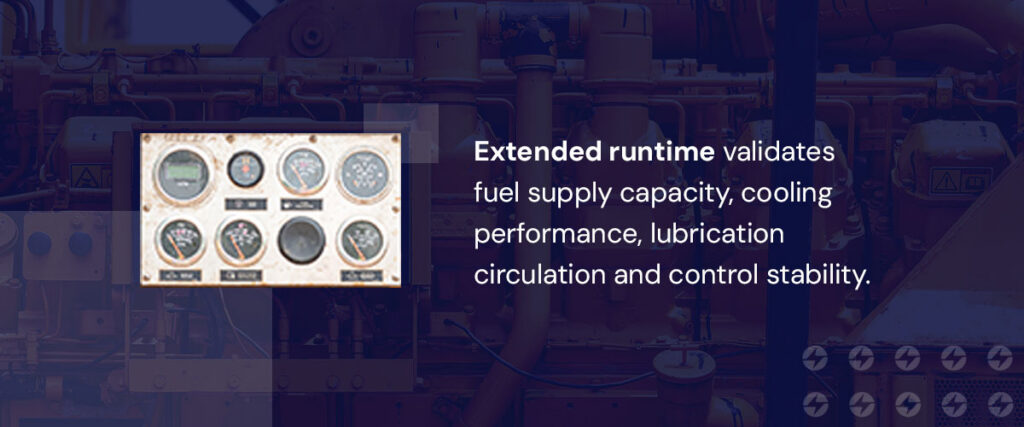
Level 1 emergency power supply systems require a 36-month test. The generator runs under load for 4 hours with the final hour sustained at 75% of nameplate kW. Extended runtime validates fuel supply capacity, cooling performance, lubrication circulation and control stability.
Beyond the Test: Critical Factors for Audit-Proof Compliance
Auditors evaluate how you manage fuel integrity, maintain documentation precision and align with hospital backup power regulations. Your procedures should describe who performs inspections, how results get recorded, when issues escalate and what corrective actions close gaps.
Strong vendor contracts and detailed service reports prove that qualified technicians support your in-house team. Consistent labeling schemes for generators, automatic transfer switches and essential distribution branches make test records easy to trace.
Fuel Quality and Management
Diesel fuel degrades over time due to water intrusion, sediment accumulation and microbial growth within tanks. Contamination builds up in filters and starves engines under load during extended outages. NFPA 110 mandates annual fuel quality testing so you can identify degradation before contamination causes failures.
Build a fuel management routine that includes sampling, laboratory analysis and tank polishing when results fall outside acceptable limits. Protect tanks from water intrusion by inspecting fill caps and seals. Sunbelt Solomon can expedite fuel system restoration when contamination issues threaten compliance timelines.
Meticulous Record-Keeping and Documentation
Maintain a dedicated logbook for each generator and automatic transfer switch. Cover weekly inspections, monthly test runs, annual maintenance and 36-month deep-dive events. Auditors must be able to trace your program’s complete history without gaps. Record:
- Dates and times.
- Test initiation methods.
- Measured loads.
- Runtime durations.
- Alarms or abnormal readings.
- Equipment failures.
- Corrective actions taken.
Attach vendor service reports, fuel analysis results and major component replacement records. Surveyors need to see the full maintenance history and verify that your program addresses issues systematically. Incomplete entries create compliance findings even when you performed the work correctly.
Understanding Your Authority Having Jurisdiction (AHJ)
Your AHJ may include the fire marshal, state health department or TJC representatives. Each interprets NFPA 110, NFPA 99 and related codes with slight variations around test methods and documentation formats.
Meet with primary regulatory contacts before scheduled surveys. Confirm their specific expectations for test cadences, initiation sequences and record structures. Your team can then follow interpretations that align with local enforcement practices to ensure you maintain healthcare facility maintenance standards. Capture agreements in written policy so staff and service vendors apply the same standards year after year.
Top Reasons Emergency Generators Fail and How to Prevent Them
Understanding why a generator fails during a power outage lets you address root causes before failures create patient safety incidents. Common reasons include:
- Battery failures from low charge states.
- Sulfation buildup or corroded terminals that prevent starting.
- Fuel contamination from aged diesel, water accumulation or microbial growth.
- Cooling system failures caused by blocked airflow, low coolant levels or failed fans.
Schedule regular load testing and proactive replacements based on manufacturer intervals. An emergency power system testing schedule and annual fuel testing, combined with polishing and filter replacement, prevent mid-run shutdowns.
Sunbelt Solomon brings the technical expertise to diagnose recurring issues and implement corrective solutions.

Get Started with Sunbelt Solomon
Hospitals can’t afford problems with their generator systems. Meeting NFPA 110 testing requirements and TJC standards can be complex, but with the right partner on your side, staying compliant can be easier and less stressful.
Sunbelt Solomon handles complex hospital load bank testing logistics while delivering the compliance records surveyors expect. We also offer temporary rentals for emergencies.
You maintain audit-ready proof without sacrificing focus on patient care. Contact our team to discuss a testing solution that keeps your generators reliable and your facility NFPA 110-compliant.