


Many transformer failures are caused by bushings, partially because bushings are a lot more exposed than other components. Lightning can strike, moisture can get in through the gaskets, and accidents can damage bushing sheds. Bushings also have to handle extreme temperatures and electrical currents. All these challenges can lead to dangerous electrical arcs, expensive repairs and significant downtime.
You aren’t the only one trying to solve these problems. At Sunbelt Solomon, we’ve been helping clients of all kinds maintain, repair and replace their bushings for years, and today, we want to share our expertise with you. We show you how to identify specific problems with your bushings, how to prevent them and how to repair them efficiently.
How Bushings Affect Your Transformer’s Health
Bushings are one of the most important protective mechanisms that transformers carry. They have two main responsibilities.
The first is to insulate high-voltage currents from the transformer’s grounded casing. These currents travel through conductors and generate an electrical field as they go. If this field isn’t insulated, the current can arc from the conductor to the transformer casing or other ground. Arcing can lead directly to fires, explosions and system failures. Bushings mitigate these risks by surrounding conductors with layers of insulating materials.
Their second responsibility is to guide the current from the windings to the local power lines safely. They have to get the windings through the grounded tank wall safely while also withstanding the heat generated by the windings themselves. The windings can then send the current into the local circuit.
In essence, bushings are gloved hands, protecting the current and guiding it where it needs to go. Different types of bushings exist, but they all serve the same purpose. For example, solid bulk bushings handle lower voltages, while oil-impregnated paper (OIP) bushings handle higher voltages. Both are designed to insulate and direct current.
The health of these bushings has a direct impact on the health of the transformer as a whole. They typically protrude from the transformer tank, exposing them to environmental weathering. The windings also regularly expose them to intense heat and electrical currents. Over time, these factors and others can lead to degradation and transformer bushing failure.
Should either of these issues occur, Sunbelt Solomon has you covered. We offer in-field repair services to keep your transformer running safely. Our highly experienced teams can also help you identify the cause of the problem and address it.
Primary Causes of Transformer Bushing Failure
Many different issues can cause bushing failure. Five of the most prominent are:
1. Moisture Ingress and Seal Degradation
Over time, bushing gaskets and terminal seals will age and deteriorate. Regular overload operation and subpar heat dissipation are often the cause. These issues will cause cracks and gaps to form, which lets atmospheric moisture penetrate the bushing’s insulation. This moisture reduces the strength of the dielectric material and can allow electrical arcs to escape the insulation. In many cases, these arcs lead to short circuits and system failures.
2. Partial Discharge (PD) Activity
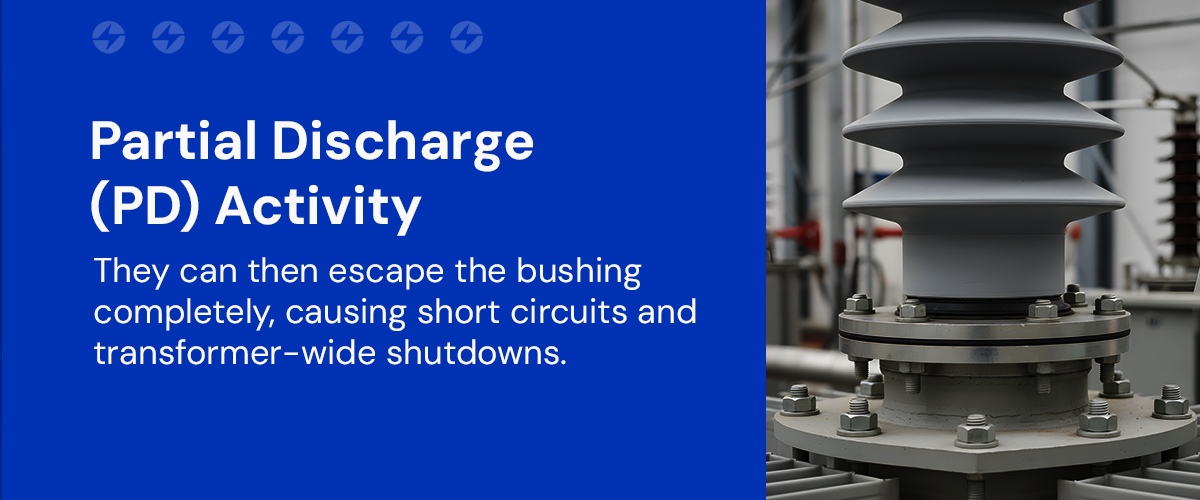
This bushing issue is the inverse of the previous one. Rather than external conditions allowing electrical arcs to escape, arcing instead wears down the insulation from within. This arcing is caused by microscopic voids in the insulation, which are themselves caused by a manufacturing error or internal wear. Localized electrical arcs can escape through these voids and widen them further. They can then escape the bushing completely, causing short circuits and transformer-wide shutdowns.
3. Thermal Instability
Part of the bushings’ job is to connect windings to the local circuit, and connections at the external terminal and internal draw-lead bridge those gaps. If they become loose, though, they can lead to unnecessary electrical losses. These losses cause increased temperatures, which lead to even more electrical losses. This snowball effect is called thermal runaway, and it can rapidly age insulation, cause fires, leak oil and shut down the entire transformer.
4. Mechanical Stress and Impact
Hairline cracks can form in transformer bushings for a number of reasons. The most prominent include:
- Local seismic activity
- Jostling during transport
- Adjacent equipment faults
These issues often cause cracks to form in the bushing’s porcelain or epoxy housing. This cracking compromises the bushing’s structural integrity and can cause both oil and electricity to leak. Should the two mix, fires can start, damaging the transformer. Local electrical arcing may also occur, leading to component damage and system shutdowns.
5. Transient Voltage Surges
All bushings come with a basic impulse level (BIL), which refers to the rated peak impulse voltage they can withstand during a voltage surge. Under most conditions, the BIL is more than enough, but some lightning strikes may exceed this number. Switching surges can also increase the voltage beyond what the bushing can handle. Should either occur, the dielectric material can break down entirely, especially if the insulation has already been weakened.
This can be especially problematic for electrical transformer components. The surge can fry them completely, and the compromised dielectric puts the entire transformer at risk. It limits the bushing’s ability to insulate the winding, increasing the risk of PD activity and total system shutdown.
Early Warning Signs of Bushing Failure
Many of the issues identified above take time to occur. Your bushing likely won’t fail all at once. In most cases, there are signs that something is wrong, giving you time to address the issue. Noticing these warning signs can save you money on costly repairs and increase transformer reliability, allowing you to count on your equipment when you need it most.
Four warning signs we see most often are:
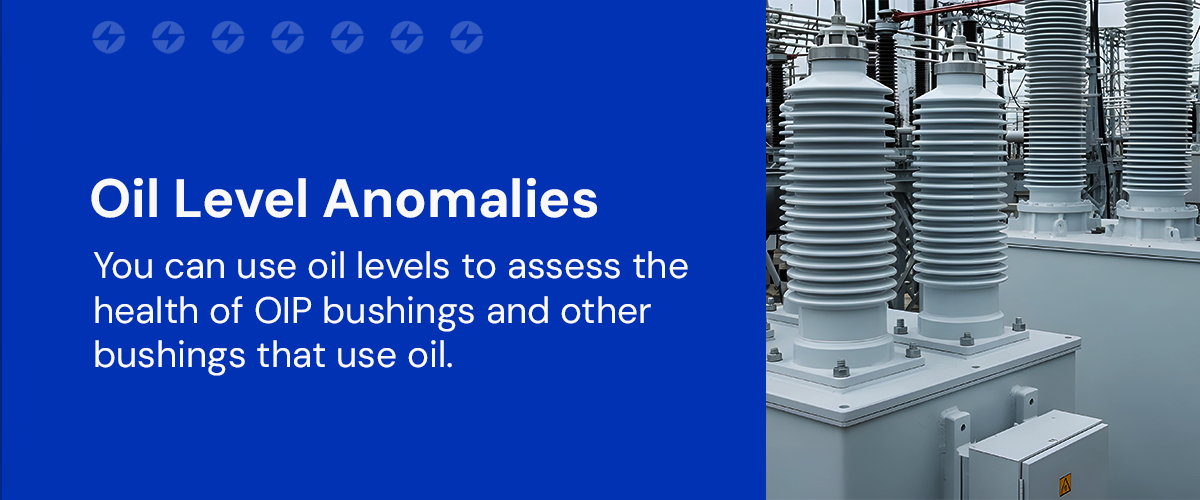
1. Oil Level Anomalies
You can use oil levels to assess the health of OIP bushings and other bushings that use oil.
If the oil levels are low, this may mean oil is actively leaking from a bushing seal, which can expose both it and other transformer components to the air. Exposure can compromise the insulation and impede its ability to contain high-voltage currents.
While bushing issues don’t typically cause high oil levels, they can exacerbate the problem. High oil levels are often caused by a fault in the winding. These faults can cause the transformer to overheat, and if PDs and thermal runaway occur, the damage will be far more severe.
So, be sure to regularly check your transformer’s oil levels. It might save you a lot of trouble.
2. Discoloration and Surface Tracking
Over time, pollutants such as dirt, salt and dust can build up on the porcelain exterior of the bushing. If this buildup gets wet, it also becomes conductive. Current from the top of the bushing can then arc to these points. Arcing leaves behind a chalky residue or, worse, makes black bands along the surface of the porcelain. Both make the bushing’s exterior more conductive, which can degrade insulation and increase the risk of flashover.
Keeping an eye out for discolorations and buildup can prevent these issues.
3. Poor Porcelain Integrity
Bushings have to withstand extreme currents, temperatures and weather phenomena. And those are just the day-to-day challenges. Freak accidents also happen, whether it’s a thrown rock striking the bushing or a tool going awry during repairs.
These conditions will eventually lead to chips, cracks and broken bushing sheds. External damage like this reduces the bushing’s effective creepage distance, increasing the risk of flashover. The danger is even greater if you’re in a damp or humid region.
Luckily, external porcelain damage is often easy to spot. Regular visual inspections and subsequent repairs are enough to prevent issues in most cases.
4. Terminal Discoloration
At the top of each bushing is a terminal connection between the internal winding and the external power line. Typically, this terminal is made of shiny copper, aluminum or other conductive materials. High contact resistance and a loose connection can cause the bushing to overheat, turning the terminal black, brown or purplish. If you notice these colors or any charring, it may mean there’s a problem with the terminal connection.
Advanced Transformer Bushing Testing Techniques
Visual inspection is a useful tool, but it isn’t always enough. Sometimes, more in-depth diagnostics are needed. The four tests below can help:
- Power factor analysis: This test assesses the health of your transformer’s insulation. It measures the cosine of the angle between the voltage passing through the insulation and the current flowing through the bushing. All bushings have a power factor just above 0% due to resistance. If the power factor is much higher than that, though, the insulation may be contaminated or deteriorating.
- Capacitance deviation measurement: Transformer bushings do more than insulate. Many also come with conductive layers that help them protect the transformer from electrical fields. These layers come with two different capacitance ratings, which are usually listed on the bushing’s nameplate. The capacitance deviation test checks to see if the conductive layers are operating within these ranges. If they aren’t, the bushing may be experiencing moisture ingress, a loss of oil or internal flashover.
- Infrared thermography (IR) scans: Loose connections at the bushing terminals or low oil levels in the body can lead to overheating. Thermal imaging cameras can help you identify this localized overheating. You can then check the connections or oil levels to determine how to proceed.
- Dissolved gas analysis (DGA): This test is specifically for bushings that incorporate oil, such as OIP bushings. Electrical and thermal stresses can cause the oil and insulation to decompose over time. This process generates a range of gases, such as methane and carbon monoxide, that then sink into the oil. A DGA can identify these gases, each of which points to particular issues in the bushing. Carbon monoxide, for example, may mean the paper or pressboard parts of the insulation are degrading.
If you’re still having trouble, contact Sunbelt Solomon. Our in-service centers across the country can help you identify and resolve the problem. We also offer reliable transformer rentals to keep your systems up and running in the meantime.
Best Preventive Maintenance Practices for Bushings
Identifying warning signs can help you keep your bushings safe, but it is just one part of an effective transformer maintenance strategy. Regular preventive maintenance practices are another. They can extend the lifespan of your equipment and save you a lot of money in the long run.
Here are four of our favorites:
- Routine cleaning: Industrial pollutants and salt deposits will build up on bushing sheds the more they’re used. Periodically clean these sheds to remove this grime, eliminating the conductive paths that can cause flashover.
- Proactive gasket replacement: Replace bushing gaskets regularly, or moisture can get in through gaps and cracks. Replacing the gasket is far less expensive than replacing the bushing’s entire insulation if it is compromised.
- Desiccant breather management: Silica gel breathers protect bushing oil by removing moisture from the air. This moisture will eventually saturate the gel, or the outside of the breather may get damaged. Regular checks on the breather can help you spot these threats before they get worse. You can then service or replace the breather as necessary.
- Online monitoring: Online transformer monitoring systems allow you to track your transformer’s performance in real time. They can help you spot developing issues that in-person testing might miss, such as leaking current. They also let you check your transformer’s health when you aren’t there in person.
How to Handle Bushing Repairs and Replacements
Preventing bushing failures can only go so far. Eventually, you will need to repair or replace your bushings or even the whole transformer. You probably can’t do without that power for long, though, so you’ll want those processes to be as efficient as possible.
At Sunbelt Solomon, we adapt our transformer repair solutions to your needs. Here are four ways we do just that:
- Damage assessment: Our highly experienced teams have the tools and knowledge to assess the health of your bushings. They can diagnose the specific causes of problems and identify relevant solutions. If the bushings have failed without contaminating the transformer tank, they can recommend repairs. If the damage extends beyond that, they can set up a total evaluation at one of our in-service centers.
- In-field repairs: If the damage can be repaired in the field, Sunbelt Solomon will do so with speed and precision. We regularly handle bushing replacements, regasketing, oil processing and more with minimal transport costs. We can even provide preventive maintenance recommendations to help you keep the transformer running safely.
- Flexible rental power: Like most of us, you probably still need power while repairs are being conducted. Sunbelt Solomon can help. We have a range of rental substations available that can provide power until we get your transformer back to you.
- Remanufactured replacement options: If your transformer is beyond repair, you don’t need to break the bank on a replacement. Sunbelt Solomon offers remanufactured transformers that are more cost-effective than factory-new units. They can also be delivered to you far faster.
Get a Service Quote From Sunbelt Solomon Today
Sunbelt Solomon has over a century of combined experience helping people just like you. We’ve repaired and replaced bushings of all shapes and sizes, and our expertise doesn’t stop there. From the tiniest silica gel breather to the largest transformer tank, we have the equipment and skill needed to get your transformer back in tip-top shape. We also have a wide array of transformers available if you’re looking for a replacement. You can even design a custom one that better suits your needs.
Get a service quote today or call us at 888-687-1487 to learn more!