

Specifying a mobile substation rental involves more than matching voltage and MVA ratings. It’s about ensuring reliable, code-compliant power for mission-critical applications where failure isn’t an option. The financial impact of power outages costs the U.S. economy billions of dollars annually. Reports show that rising power outages and mounting grid reliability risks make planning for temporary power critical.
After reading this guide, you will have the technical confidence and vocabulary to accurately specify the right mobile substation for your application, evaluate vendor proposals with clarity and confidently justify your rental decision to stakeholders.
Understanding Mobile Substation Ratings
Mobile substation ratings start with four core specifications that define equipment performance and safety margins. These parameters form the foundation of any mobile substation specification and directly impact your ability to integrate temporary power equipment into existing infrastructure.
Voltage Class Selection
Voltage classification determines which equipment can safely operate within your system. Medium-voltage (MV) equipment — typically ranging from 1 kilovolt (kV) to 69 kV — represents the most common voltage for mobile substation applications. High-voltage (HV) units exceeding 69 kV serve transmission-level applications.
Mobile substations typically feature high-side voltages up to 230 kV.
MVA Capacity Sizing
Sizing transformer capacity requires understanding megavolt-ampere (MVA) ratings, which define the power-handling capacity of your equipment. Mobile units typically range from 10 MVA to 100 MVA, and those under 50 MVA represent the most deployable configurations for rapid response.
Account for continuous load requirements and short-duration peaks when sizing. Undersizing creates overheating risks and premature failure, while excessive oversizing increases rental costs. Evaluate load profiles over the entire rental period, including seasonal variations and planned expansions.
BIL and Insulation Coordination
Lightning strikes and switching operations generate voltage surges that equipment must survive. Basic Impulse Level (BIL) ratings quantify the amount of transient overvoltage the insulation system can withstand without failing. Higher BIL ratings provide greater safety margins but increase equipment size and cost. Proper insulation coordination between the mobile unit and existing infrastructure prevents cascading failures during fault conditions.
Your specification should align BIL ratings with protection systems already in place at the connection point.
Short Circuit Ratings
Fault conditions can destroy equipment in seconds. The short circuit withstand capability determines whether your equipment survives these events without catastrophic failure. In a direct temporary vs. permanent substation comparison, mobile units may have different impedance characteristics than permanent installations, which can affect available fault current levels.
Verify that downstream protective devices can interrupt the fault levels your temporary installation may introduce.
Design Standards That Matter
Once you understand core ratings, verify that equipment aligns with industry standards for safety, reliability and interoperability. A reputable rental provider should demonstrate compliance with these benchmarks.
IEC 62271-200 for Switchgear
The International Electrotechnical Commission (IEC) 62271-200 standard governs metal-enclosed switchgear and controlgear for medium-voltage applications. This standard establishes type-testing requirements, including:
- Temperature-rise validation
- Short-circuit withstand tests
- Internal arc classification
Equipment certified to this standard has undergone rigorous testing to ensure reliable performance under normal and fault conditions. Mobile substation design standards require switchgear that can withstand the mechanical stresses of transport while maintaining the same performance as in stationary installations.
IEEE C37 Series for Protection
The Institute of Electrical and Electronics Engineers (IEEE) C37 series covers protective relaying and control systems essential for safe substation operation. These standards define how equipment detects faults, coordinates protective actions and prevents damage propagation.
Mobile substations must integrate seamlessly with utility protection schemes to avoid miscoordination that could delay fault clearing or cause unnecessary outages. When specifying equipment, confirm that protection systems follow these standards and can communicate with your existing supervisory control and data acquisition (SCADA) infrastructure.
Factory Testing Requirements
Factory acceptance testing validates equipment performance before deployment. Type testing proves a design satisfies specifications through the evaluation of a representative unit. Routine testing verifies that each manufactured unit operates correctly.
For mobile substations, testing should include power frequency withstand tests, impulse voltage tests and load verification.
Environmental Ratings
IP54 ingress protection ratings ensure enclosures resist dust infiltration and water spray from any direction. Consider site-specific environmental factors, including:
- Altitude
- Humidity
- Seismic activity
- Exposure to corrosive atmospheres
Equipment that performs reliably in controlled factory conditions may fail when exposed to coastal salt spray or desert temperature swings.
Application-Driven Specification
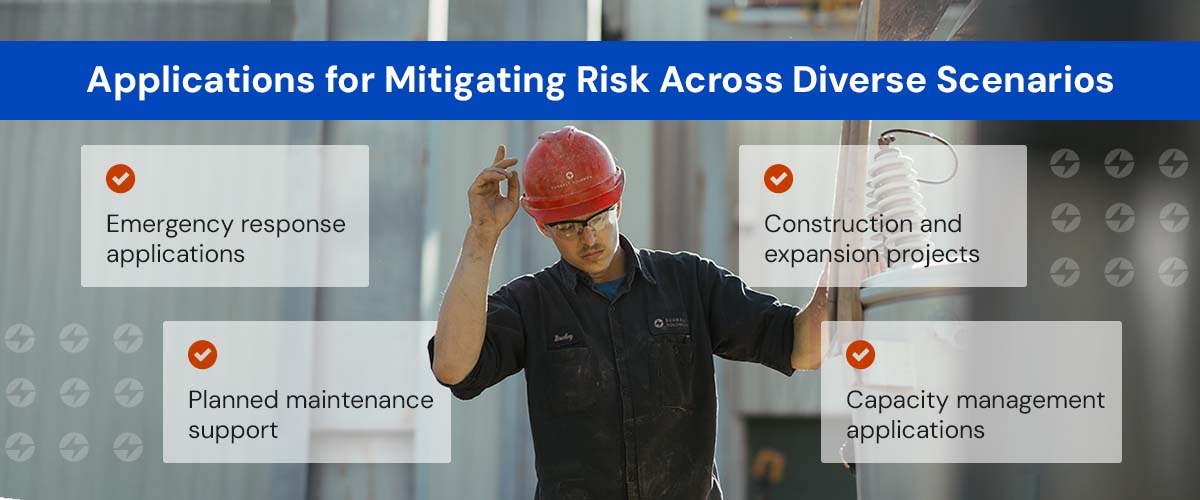
High-voltage portable power applications require different specification priorities depending on your operational scenario. The right equipment for emergency response differs significantly from what planned maintenance demands.
Emergency Response
Emergency scenarios prioritize rapid deployment power systems. As extreme weather events become more common, mobile substations serve as grid hardening tools. Deployment windows of 12 to 24 hours demand preconfigured, road-ready units that require minimal on-site assembly.
Reliability under stress becomes paramount when emergency response teams depend on immediate restoration. Specifications should emphasize proven designs, redundant systems and supplier responsiveness. Recent Federal Energy Regulatory Commission (FERC) action establishes new reliability safeguards emphasizing the need to strengthen the American grid.
Planned Maintenance
Scheduled outages allow more flexibility in equipment selection and deployment timing. Facility managers can optimize for exact capacity matching and minimize rental duration. Coordination with maintenance crews determines ideal delivery windows and connection sequences.
Unlike emergency scenarios, planned maintenance enables detailed site preparation, thorough commissioning and systematic testing before energization.
Load Growth Support
Temporary capacity increases address load growth while permanent infrastructure upgrades proceed. These applications may require parallel operation with existing equipment or staged capacity additions as demand materializes.
Scalability considerations include:
- Available space for equipment placement
- Connection point compatibility
- Future expansion potential
Energy professionals specifying for load growth should evaluate whether temporary solutions can transition to semi-permanent installations if project timelines extend.
Systems for Remote Locations
Remote site applications often lack nearby technical support or ready access to spare components. Self-contained systems must include auxiliary power supplies, comprehensive monitoring equipment and robust protection systems that operate reliably without constant oversight.
Transportation logistics may limit equipment size and require special permits or route surveys. Consider whether site conditions allow heavy-haul trucking or if equipment must arrive via rail or barge.
Rental-Specific Considerations
Execution requires addressing logistical and service aspects unique to temporary installations, sometimes requiring cross-functional collaboration.
Key considerations include:
- Deployment timeline and site prep: Confirm delivery lead times, transportation permits and site accessibility. Heavy mobile units may weigh in excess of 100,000 pounds and require reinforced foundations or graded pads. Utility coordination for outage windows and energization procedures must align with equipment arrival.
- Integration with existing infrastructure: Verify cable termination compatibility, bushing configurations and physical connection interfaces. Mobile equipment must match existing voltage levels, phasing sequences and grounding schemes.
- SCADA/monitoring capabilities: SCADA integration allows operators to track loading, temperatures and alarm conditions from central control facilities. Confirm communication protocols match your existing systems or if they require protocol converters.
- Maintenance and support: Clarify responsibility for routine inspections, oil sampling and cooling system maintenance. Establish response times for technical support and spare parts availability. Premier rental providers offer field service teams who understand both the equipment and your operational requirements.
Temporary vs. Permanent Substation Comparison
While buying a transformer for permanent installation has its place, renting offers significant advantages for temporary or uncertain-duration needs. Before deciding, consider the following:
- Financial analysis: Permanent substation installations require significant capital investment. Rental converts this to an operational expense, preserving capital for core business activities.
- Flexibility and scalability: Rental agreements provide flexibility to adjust capacity as needs evolve. Utilities can deploy mobile units to address temporary load increases without committing to permanent infrastructure.
- Asset management burden: Ownership creates ongoing responsibilities for maintenance, testing, spare parts inventory and disposal. Rental providers absorb these burdens, allowing facility managers to focus on core operations.
- When to choose each option: Choose permanent installations when load requirements are stable and long-term. Select rental solutions for emergency backup, bridging gaps during equipment replacement or supporting construction projects with defined end dates. Many organizations maintain a hybrid approach, owning permanent infrastructure while accessing rental equipment for contingency scenarios.
Partner With Experts Who Understand Your Specifications
Mobile substation specifications are complex. With over 50 years of experience, Sunbelt Solomon’s team provides comprehensive substation services to help you select the precise ratings, standards compliance and deployment approach for your project.
Don’t leave your critical power needs to chance. Our team of substation experts can provide application-specific guidance on your next mobile substation rental.