

When power outages strike industrial facilities, the consequences extend far beyond temporary inconvenience. Manufacturing downtime costs, spoiled materials, idle crews, missed deadlines and strained customer relationships can cost operations tens of thousands to millions.
For those developing a comprehensive industrial power outage contingency plan, understanding mobile substations is essential. While standard generators provide backup power for critical circuits and Uninterruptible Power Supply (UPS) systems offer momentary ride-through capabilities, mobile substations address a distinct and critical gap — the failure of the primary electrical distribution infrastructure itself.
By restoring this foundational power delivery, they can transform a widespread facility crisis into a managed and less disruptive interruption. This makes a mobile substation rental a key part of your resilient grid and risk mitigation strategy and an insurance policy against the costs of downtime.
The High Cost of Downtime: Understanding Your Operational Risk
Not all power outages affect operations equally. Grid fluctuations and brief interruptions can last minutes, hours or days, allowing backup generators to maintain essential circuits. However, infrastructure failures present more complex challenges. When substation transformers fail, utility maintenance extends beyond scheduled windows or an error occurs, the problem often lies within the electrical distribution infrastructure itself.
Manufacturing facilities, data centers and other industrial applications face particularly severe consequences during extended outages, with automotive manufacturers alone losing an estimated $2.3 million for each hour of downtime. Even small and medium-sized manufacturers report up to $150,000 in hourly losses — an amount that could prove catastrophic for many. In data centers, over half of respondents reported losing more than $100,000 in their most recent outage. That figure rose to more than $1 million for 1 in 5.
Downtime incurs these losses in multiple ways, such as:
- Loss of revenue
- Cost of wages for staff unable to work
- Repair or replacement parts and servicing
- Penalties due to failure to fulfil contractual obligations
Temperature-sensitive operations and continuous process industries face exponential losses as outage duration increases.
Why Standard Generators Fall Short of Comprehensive Risk Protection
Most facilities invest in backup generators as part of their emergency planning. Generators excel at producing electricity to maintain essential circuits during short to moderate outages. However, they are limited when the core electrical distribution infrastructure itself fails.
Generators are primarily designed for power generation, not the complex management or distribution of electricity at the scale required for full facility operations. When the electrical systems responsible for receiving, transforming and routing power throughout a facility become compromised or damaged, simply generating more power doesn’t solve the fundamental problem.
Backup generators are also often configured to power only predetermined emergency or critical circuits, leaving the majority of operations offline. While this selective approach can be highly effective for life safety systems and essential processes, it often falls short of supporting full production capacity. In integrated or highly interconnected operations, relying solely on partial power can leave entire production lines or critical processes inoperable.
Mobile substations are specifically engineered to bridge this critical gap. By rapidly restoring the entire distribution infrastructure, they enable a much more comprehensive return to operational capacity, effectively moving facilities from emergency survival mode to sustained productivity.
How Mobile Substations Are a Strategic Asset for Power Continuity
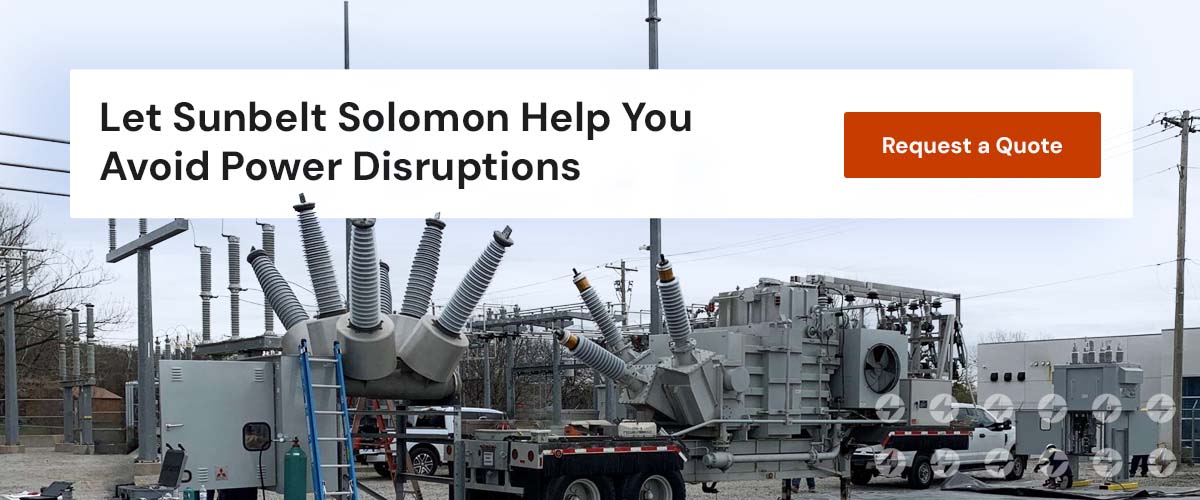
Mobile substations are complete electrical distribution systems engineered for rapid deployment. Unlike generators that produce electricity, these units manage and distribute power at utility scale. Each system includes transformers, switchgear, protective relays, metering equipment and control systems, all preassembled and factory tested for immediate operation.
Once connected, the mobile substation temporarily assumes the role of a permanent substation that is damaged or offline. This means the entire operation receives full power, not just the critical circuits that emergency generators typically cover.
This comprehensive power-restoration capability makes mobile substations essential for the recovery of electrical infrastructure during disasters. They let you maintain full operational capacity while underlying issues are resolved.
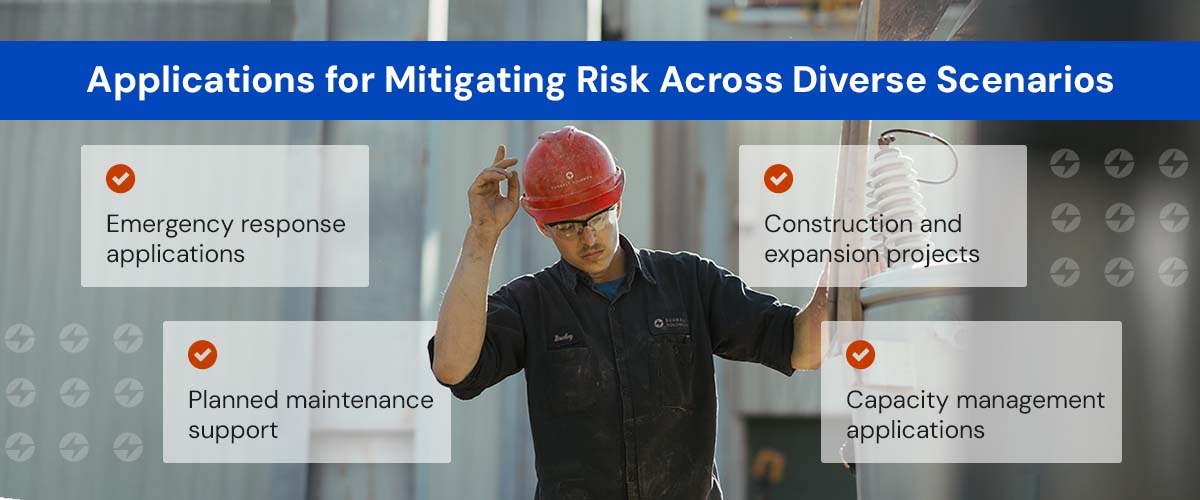
Applications for Mitigating Risk Across Diverse Scenarios
Mobile substations serve multiple strategic functions beyond emergency response. Understanding these applications helps recognize their broader value for operational planning:
- Emergency response applications: When facilities face transformer failures, significant weather damage or equipment malfunctions that require lengthy permanent replacements, mobile substations provide a swift solution. They can restore power distribution and become operational in a fraction of the time, often saving weeks or months of potential downtime.
- Planned maintenance support: Mobile substations enable proactive risk management to maintain full capacity during scheduled substation maintenance, transformer testing or system upgrades. This eliminates the need to shut down production or operate on limited generator power during maintenance windows.
- Construction and expansion projects: When new facilities need temporary power before permanent infrastructure is completed, or when existing operations expand beyond current substation capacity, substations can provide immediate full power capability while permanent solutions are engineered and installed. This helps mitigate potential power delay or insufficient capacity.
- Capacity management applications: Mobile substations offer flexibility to match power supply with dynamic demand patterns. This reduces the risk of overloaded systems, inadequate supply or contractual penalties during peak demands.
How the Rental Model Offers Flexibility Without Capital Investment
Most organizations access mobile substations through rental agreements rather than ownership, offering significant advantages for emergency planning and operational flexibility. Rental agreements provide immediate access to appropriate equipment without substantial capital expenditure, storage requirements or ongoing maintenance responsibilities. This model accommodates a range of deployment durations, from 48-hour emergency responses to multi-month maintenance projects.
Provider selection significantly impacts deployment success. As a trusted temporary power equipment rental company, Sunbelt Solomon maintains a focused yet extensive inventory of mobile substations, transformers, switchgear and associated equipment across multiple voltage classes and power ratings. This specialized inventory ensures you always have access to the precise equipment needed, mitigating the risk of an inadequate or incompatible solution.
With industry-leading scale and locations across North America, including the U.S., Canada and Mexico, collaborating with us can significantly reduce your response time risk. If a necessary unit isn’t available at one location, our interconnected network quickly identifies and mobilizes equipment from another, ensuring rapid deployment when you need it most.
Sunbelt Solomon: Your Comprehensive Power Risk Management Partner
Provider capabilities vary significantly across the temporary power equipment industry, making careful selection crucial for successful deployments. Here is what sets Sunbelt Solomon apart as your partner in power risk management:
- Technical expertise: Sunbelt Solomon’s technical expertise is unparalleled. Our qualified technicians are adept at high-voltage installations, protective relay settings and system testing. We collaborate directly with you to find the best unit arrangement for your power demands, safeguarding against the significant risks and dangers posed by inappropriate units.
- Dedicated life cycle support: Our comprehensive field service team ensures your mobile substation is installed with best practices, eliminating the risks associated with third-party installers and guaranteeing quality installations. This dedicated support means you only have to go to one place for complete peace of mind. Beyond emergency response, Sunbelt Solomon provides a true one-stop shop for your entire power system life cycle, minimizing risk at every stage.
- Focus on sustainability: Our commitment to products built to last, combined with our expertise in designing complete turnkey solutions, means every piece of equipment is engineered for continuous benefits and optimal sustainability. This proactive approach reduces long-term operational risks and ensures your power infrastructure remains robust.
- Commitment to safety: Sunbelt Solomon is committed to keeping safety at the forefront. This is why we work with you on a maintenance plan to keep your electrical distribution equipment performing its best. Our expert technicians provide field service, and our service centers are equipped to repair and recondition equipment and parts to like-new condition, extending the life of your power systems and mitigating future risks.
Let Sunbelt Solomon Help You Avoid Power Disruptions
Sunbelt Solomon combines an extensive inventory of temporary power equipment with comprehensive field service capabilities and 24/7 emergency response across North America. From initial emergency calls through complete system commissioning and ongoing life cycle support, our integrated approach eliminates coordination challenges. Trust in our expertise in transformers and power equipment services to deliver the speed, inventory availability and technical knowledge essential for successful mobile substation deployments.
Contact Sunbelt Solomon or use the quote builder tool to discuss your power continuity requirements and develop customized risk mitigation strategies to safeguard against downtime.