

Transformers and other power distribution systems can’t function safely without electrical impedance. Think of this mechanism as an invisible traffic cop, dictating how electricity flows during regular operation and in the event of faults. Without it, high-voltage currents would flow directly into your local circuit, causing an overload. However, if impedance is too high, it can starve your circuit of voltage.
The impact of electrical impedance doesn’t stop there. It affects your short-circuit protection, your transformer’s efficiency and several other factors. If you master it, you can improve all these features.
What Is Electrical Impedance in Transformers?
Alternating electrical currents power transformers and other electrical systems. Because these currents must travel long distances, they often come in high voltages. They also periodically change their directional flow between positive and negative voltage.
Electrical impedance, measured in ohms, turns high-powered alternating current into safe, usable energy. The existing voltage is much too high for the transformer to send out into the local circuit. So, the transformer uses some of the primary voltage to circulate the full-load current through a short-circuited secondary winding. The winding then scales down the voltage for future use.
Electrical impedance has two components — resistance and reactance.
- Resistance refers to the friction the AC experiences when it flows through windings made of materials like rubber or plastic. This process heats the windings and decreases the voltage. It negligibly influences AC impedance, but it is the primary impedance method for a direct current.
- Reactance refers to the use of magnetic and electrical fields to store excess voltage. Inductor and capacitor components then release the energy back into the circuit when it’s safe. This process is at the heart of AC impedance and allows transformers to respond to voltage polarity changes.
The combined voltage lost during resistance and reactance equals impedance percentage. The standard impedance percentage varies based on the scale and type of transformer in use. For example, liquid-immersed power transformers tend to have higher impedance percentages than low-voltage distribution transformers. Sunbelt Solomon carries a wide range, so you can find the perfect transformer for your needs.
How Impedance Affects Voltage Regulation and Short-Circuit Protection
Electrical impedance directly relates to voltage regulation and short-circuit protection.
Voltage regulation is all about maintaining a stable output voltage, regardless of how the load changes. Impedance supports these efforts by minimizing voltage drop, ensuring even large motors won’t cause light flicker or programmable logic controller trips upon startup.
Short-circuit protection keeps transformers and the circuit safe in case of a fault. Without it, the circuit could overheat, start fires, damage winding and fry the entire electrical system. Short-circuit impedance minimizes these risks by decreasing the magnitude of fault currents.
Impedance supports power system stability by strengthening voltage regulation and short-circuit protection. It ensures transformers run safely and consistently, but it needs adequate maintenance to do so. If your transformer needs repairs, Sunbelt Solomon can service it in the field and minimize disruptions to your daily operations.
The Link Between Transformer Impedance and Transformer Efficiency
Electrical impedance impacts your transformer’s efficiency in two notable ways.
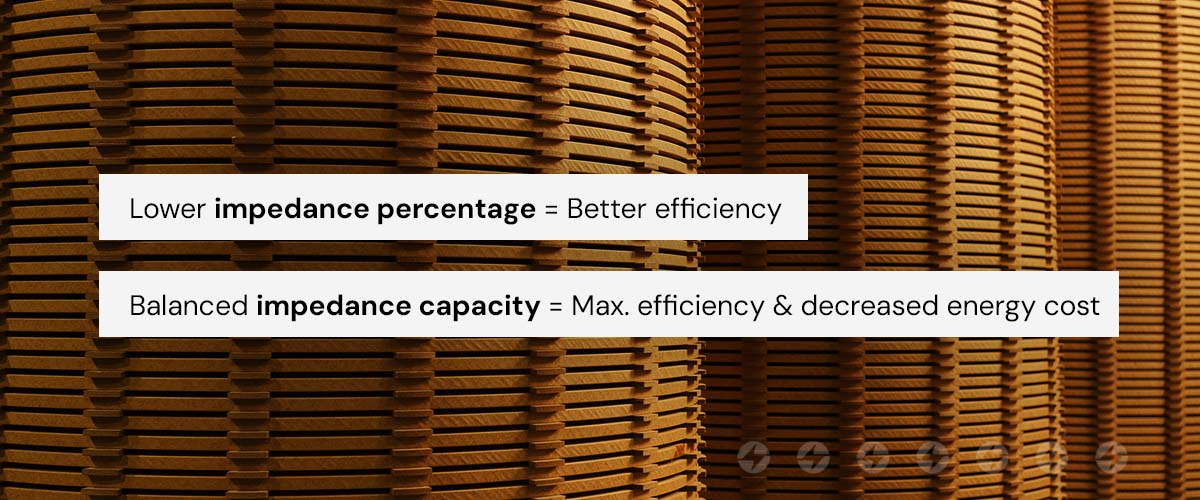
- Impedance percentage determines how much voltage you lose due to resistance and reactance. More efficient units tend to have a lower impedance percentage. They may also use unique coil geometries or conductor masses to further reduce impedance percentage.
- Impedance capacity determines the maximum voltage your transformer can handle. If the impedance is too weak, the transformer will be incapable of handling the input voltage, which can lead directly to faults, damaged equipment and system failures. If the impedance is too strong, it can stifle the transformer’s efficiency. Finding a balance between the two maximizes efficiency and decreases energy costs.
Switchgear, such as circuit breakers, must also be able to handle the new voltage. At Sunbelt Solomon, you can find all the switchgear you need to make your transformer run safely. You can even rent temporary power equipment to find your ideal setup.
The Danger of Mismatched Impedance in Parallel Operation
Many industrial facilities and other high-demand settings use multiple transformers. These transformers run in parallel, sharing the electrical load. They need similar impedance capacities to do this safely.
If the transformers aren’t capable of handling the same voltage, problems will arise. The one with the lower impedance will shoulder a disproportionate share of the load. This imbalance can lead to overheating and system failure in one unit while the other remains underused. The problems don’t stop there, either. Repairing the damaged transformer can be costly, as can the additional energy costs resulting from decreased efficiency.
Sunbelt Solomon can help you prevent these issues. We offer parts and components to upgrade your transformer’s impedance capacity. Our highly experienced team can also recommend the appropriate transformers for your electrical needs.
Specifying the Right Impedance for Your Application
Before selecting a transformer, consider your expectations. Standard impedance levels are typically sufficient for general loads, but you may need custom impedance if you’re near a substation or dealing with a sizable input voltage.
To assess your transformer’s suitability, you should:
- Verify the main breaker’s ampere interrupting capacity rating
- Calculate the maximum fault current for the new transformer
- Ensure the motor starting voltage drop is acceptable
If the transformer aligns with all three checks, it will likely be able to handle your needs. If you still have questions, reach out to us at Sunbelt Solomon. Our team of professionals has the firsthand experience and technical knowledge to ensure your transformer’s impedance is just right.

Discover Your Ideal Transformer at Sunbelt Solomon
Partnering with Sunbelt Solomon gives you access to over a century of combined experience. In that time, our teams have worked tirelessly to provide custom electrical solutions to utility, industrial and commercial clients, and we continue to do so today. But that’s not our only specialty. We also offer rentals, repairs, recycling and sales. Whether you’re looking to upgrade old equipment or invest in something new, Sunbelt Solomon has your back.
To learn more about our services, request a quote today or reach out at 888-687-1487.